AI is rewriting the rules of pricing through AI personalization in retail. Here’s why paying full price might be the smartest thing your customer ever does and your smartest move as a brand.
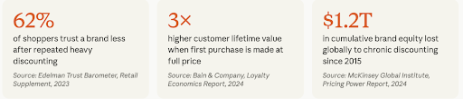
Remember when every brand screamed “50% Off!” to grab your attention? Those days are fading fast. The discount economy that defined digital retail for the past decade is quietly unraveling, and in its place, something far more interesting is emerging: AI-powered value and AI personalization in retail.
This is a story about what happens when brands stop begging for attention with price cuts and start earning it with intelligence. Think about the last time a brand genuinely surprised you. Not with a coupon or a flash sale, but with an experience that made you feel like they actually knew you. Chances are, you bought something without checking whether it was on sale. You just… bought it. That feeling of being understood rather than chased is what AI is making possible at scale through retail personalization. And it is quietly turning the economics of modern retail on its head. Yet for most brands, getting there isn’t instinctive. Decades of discount-led marketing have left teams optimizing for the short spike rather than a long relationship, and the data pipelines, incentive structures, and creative habits that powered those tactics don’t simply switch off overnight. In this piece, I want to unpack exactly why the discount model is breaking down, what AI-driven personalization looks like when it’s done right, and, more practically, what marketing leaders can do this year to start pricing with confidence instead of apology.
The problem with perpetual discounts and how we trained customers to wait
We’ve all done it. Rolled out a flash sale. Stacked a “buy-more-save-more” offer. Blasted a last-chance email to a tired list. For a while, these tactics worked beautifully, driving traffic, clearing inventory, and boosting quarterly numbers.
But over time, a quiet erosion set in. The margin pressure was obvious, but the identity pressure was less obvious until the data caught up. When your brand is always on sale, customers stop associating it with quality or craft. They associate it with the deals. And deal-hunters are the least loyal cohort in any customer base.
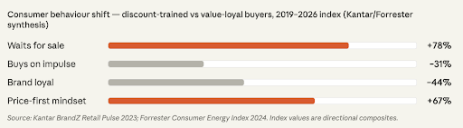
The data tells a disturbing story. Brands that trained their customers to hunt discounts found themselves trapped. They were unable to raise prices, unable to hold margin, and unable to tell a compelling story beyond “cheaper than yesterday.”
You can’t build a premium brand on a discount foundation. You can only build a discount brand and then spend years trying to escape it.
Where AI changes everything
Here’s where the story gets interesting for AI personalization in retail. AI doesn’t look at your customer and ask, “What discount will close this sale?” It asks something fundamentally different: “What does this person actually need right now, and what’s stopping them from buying it?”
Those are very different questions. A customer browsing a premium skincare product at 11pm after reading three editorial reviews isn’t looking for 20% off. They’re looking for reassurance – that this is the right choice. An AI system that has tracked the customer’s journey can deliver a level of retail personalization that a discount code cannot.
How AI replaces the discount: three shifts that change everything
A discount doesn’t make a customer confident. It just makes the risk of being wrong feel cheaper. AI addresses the root. Here’s how the shift happens across three interconnected layers, moving a customer from price-sensitive to genuinely loyal.
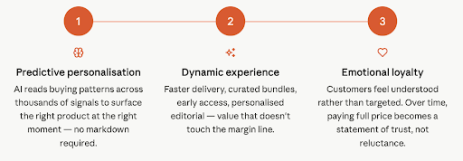
And it is one of the biggest reasons why the most forward-thinking brands are now investing in understanding over discounting.
The new full price proposition
What’s emerging from these brands right now is what you might call the full-price proposition. It’s not about raising prices or being precious about promotions. It’s about earning the right to charge your price by making the customer experience feel personal enough that the price stops being the primary variable in the decision.
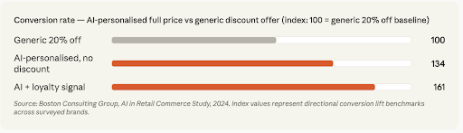
Brands that have moved in this direction are seeing something that would have seemed
counterintuitive five years ago: their full-price conversion rates are outperforming their discounted campaigns. Not because they’ve found better coupons but because they’ve stopped using coupons as a substitute for understanding.
How marketers can lead the shift
Making this shift isn’t painless. It requires rethinking what your data is for, what success looks like, and frankly, what story you’re telling about your brand. But the path is clearer than it might look for organizations investing in AI personalization in retail and broader retail digital transformation initiatives :
- Audit what your AI is actually learning
Is your AI learning from the right signals — browsing depth, scroll behavior, purchase history, sentiment from reviews, and support tickets? If your AI is trained only on purchase history, it’s flying blind, limiting the potential of AI in retail. - Replace discount codes with curation
Let recommendation engines do the work your discount emails used to do. A perfectly timed product suggestion converts without training customers to expect a deal. - Reframe your value story, not just your price story
Communicate craft, sustainability, and quality. Give customers a reason to be proud of paying full price, not apologetic about it, and create a stronger retail customer experience. - Measure loyalty, not just clicks
Track repeat purchase rate, average order value over 12 months, and time between purchases. These loyalty metrics tell you whether you’re building something real or just renting attention.- Stop asking “what discount will close this?” Ask “what context is missing?”
- Invest in zero-party data — let customers tell you what they love
- Build pricing confidence into your brand voice, not just your product
- Test AI-personalized full-price journeys against your discount control group
The cultural shift beneath the strategy
From a broader perspective, the move away from discounts isn’t just a revenue play; it’s a cultural one. Chronic discounting quietly communicates something troubling: that your product isn’t worth what you’re asking for it. Customers absorb that signal, even when they can’t articulate it.
When your brand shows up with personalization, curation, and genuine understanding instead, something different happens. Price sensitivity drops because certainty rises. The customer isn’t buying despite the price; they’re buying because of everything that justifies it.
Connection converts better than coupons. AI doesn’t change that truth — it finally gives us the infrastructure to act on it.
The winning brands of the next decade won’t discount harder. They’ll understand deeper. They’ll use AI not as a margin-cutting tool, but as an empathy engine — one that makes every customer feel like the product was made for them.
That’s not the end of the deal. It’s the beginning of intelligent value. And for brands willing to make the shift, it’s the most powerful pricing strategy in a generation.
So where does this leave us?
Let’s come back to where we started. Two problems have been quietly compounding in parallel inside most commerce organizations. The first is structural: years of discount-led marketing created an entire generation of customers who have been trained to wait, to compare, to never pay full price if patience will be rewarded. The second is operational: most brands already sit on mountains of behavioral data (browsing signals, purchase history, sentiment, engagement patterns), but they’ve never had the tools, the strategy, or the organizational will to turn that data into genuine personalization at scale.
These aren’t separate problems. The discount trap occurs when the personalization gap goes unfilled for too long. When a brand can’t make an experience feel relevant, it reaches for a price cut instead. And every time it does, the customer learns a little more to expect it.
Breaking that cycle isn’t a technology problem — it’s a transformation problem. The AI tools exist. The data exists. What most organizations are missing is the bridge: a clear-eyed strategy that dismantles dependency on discounts, rebuilds the data pipeline around intent rather than transactions, and designs experiences that earn trust before asking for a sale.
That’s where Globant GUT Studio comes in
We help brands stop competing on price and start competing on understanding, rebuilding data pipelines around intent, designing experiences that earn full price, and driving the kind of Digital Transformation that sticks. If this sounds like where your team needs to go, visit Globant’s GUT Network and let’s talk.
Are you training your customers to wait for discounts, or teaching them why you’re worth every penny? In the age of AI, those two paths lead to entirely different brands. The choice is yours—and this decade is the deadline.