Robotics has officially graduated from an isolated automation luxury to a core operational infrastructure. At this year’s Robotics Summit & Expo, the conversation shifted decisively away from what robots can do, toward how fast enterprises can scale them. In an era defined by labor shortages and the need for hyper-resilient supply chains, the integration of advanced machine learning into physical hardware, Physical AI, has become the next massive competitive battleground.
Physical AI is the integration of advanced AI models with robotic and physical systems: machines that perceive, reason, and act in the real world, continuously learning from what they encounter. The technology has matured enough that deployment is no longer the question. Scale, reliability, and long-term operations are.
Imagine a logistics operator running a mixed fleet of autonomous mobile robots, robotic picking arms, and AI-guided conveyor systems. Each subsystem generates data. Each one is capable of adapting its behavior based on that data. The question that keeps engineering teams up at night isn’t “can we make this work?” They’ve already proven they can. The question is: “can we keep it working — across three shifts, six facilities, and the next four software updates?”
That gap between capability and operational reality is the defining engineering challenge of Physical AI at the enterprise scale.
Perception Is Evolving Beyond Traditional Computer Vision
Robotic perception is undergoing a significant transformation. Traditional machine vision systems often relied on rigid rules, predefined patterns, and highly controlled environments. Today’s AI models are enabling robots to interpret more complex and dynamic scenarios. This shift is particularly important in industrial environments where variability is the norm rather than the exception.
However, better perception introduces new challenges. Teams must determine how much real-world data is needed, when synthetic data can accelerate development, and how to continuously improve models once they are deployed.
For many organizations, the bottleneck is no longer model capability. It is building the operational infrastructure that allows those models to learn, adapt, and perform reliably over time in production environments.
Why Software Is Becoming the Competitive Advantage
Physical AI systems compete on intelligence, not mechanics. Two organizations can source identical hardware and achieve dramatically different outcomes depending on how well they can develop, deploy, monitor, and continuously improve the AI layer running on top of it.
This changes how organizations need to think about robotics investment. Hardware is increasingly commoditized. The ability to rapidly develop, deploy, monitor, and continuously improve intelligent systems is becoming just as important as the physical capabilities of the robot itself.
As AI capabilities evolve, organizations need development models that allow them to move faster while maintaining quality, governance, and operational reliability.
At Globant, this is the shift we’ve been building toward in our High Tech Studio: from robot integration to intelligent system development, where the software stack is the primary source of competitive value.
Scalability and Physical AI
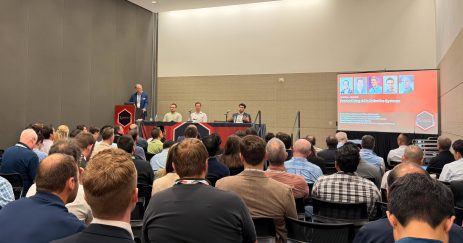
Nowhere was the robotics shift more apparent than in the panel, “Productionizing AI in Robotic Systems.” Bringing together executive and technical minds from Globant, Path Robotics, Universal Robots, and PickNik Robotics, the discussion laid out a tactical blueprint for the enterprise. It explored how companies are moving past proofs-of-concept to deploy intelligent, adaptable robotic fleets that serve as the scalable backbone of modern business operations.
During Globant’s intervention, Diego Brihuega zeroed in on a core theme that resonated deeply with the audience: Physical AI and Scalability.
The industry frequently hypes the imminent arrival of a “general-purpose” robotic AI — one model that can handle any task in any environment. The reality in production is more grounded, and more instructive: the systems delivering real enterprise value today are highly specialized expert models, built and optimized for a defined task in a defined environment.
AI is the ultimate enabler that allows enterprises to integrate robots seamlessly into diverse workflows and operational ecosystems. By capturing and utilizing real-time data, robots become increasingly reliable, shifting from isolated automation tools to the very backbone of enterprise operations.
Technical Debt is the Real Risk
Moving fast in robotics is tempting. Deploying an AI model on existing hardware, integrating it with whatever architecture is already running, and shipping before the next planning cycle — this is how a lot of enterprise robotics projects start.
The problem surfaces 18 months later. Legacy hardware frameworks without clean software abstractions make fleet management nearly impossible at scale. Monolithic codebases mean that updating one robot’s behavior requires touching everything. Models deployed without proper monitoring drift silently until they fail visibly.
Physical AI at scale requires modular software architecture from the start: clean interfaces between the perception layer, the planning layer, and the execution layer; telemetry infrastructure that captures behavioral signals continuously; and OTA update pipelines that allow models and firmware to evolve independently without downtime.
AI Pods: Globant’s Engine for Enterprise-Ready Execution
Deploying a robot successfully is one problem. Keeping a fleet of robots running reliably — across shifts, facilities, and software generations — is a different discipline entirely, and it’s where most enterprise robotics programs underinvest.
As the market matures, the organizations best positioned for 2028 and beyond won’t necessarily be those with the most advanced robots. They’ll be those that built the best operational intelligence around their fleets — and the engineering teams capable of improving those systems continuously.
At Globant, we work through specialized multidisciplinary teams that embed engineering, AI, and simulation expertise directly into client programs.
Through this flexible model, Globant delivers four core pillars:
- Simulation-First Robotics: Powered by digital twins and NVIDIA Omniverse.
- AI + Edge Intelligence: For real-time, low-latency robotic decision-making on the fly.
- RobOps & Fleet Orchestration: To manage and scale complex, multi-vendor robotics ecosystems.
- Intelligent Automation: Improving overall operational efficiency, resilience, and adaptability.
Hype vs. Reality: The Road to 2028
Physical AI is no longer a future-state investment. It’s an operational question enterprises are answering right now — in warehouses, on factory floors, in hospitals, and across logistics networks.
The practical guidance is simple, even if the execution isn’t: don’t try to deploy AI across your entire fleet simultaneously. Identify one high-value, well-defined use case. Invest in your data infrastructure at the edge before you scale your models. Build software architecture you can evolve — not one you’ll have to replace. And treat the operational layer with the same rigor you give to the AI layer itself.
The robots that will define the next decade are already being deployed. The question is whether the software and operational intelligence surrounding them will be ready to grow with them.