It’s no secret that large language models, including ChatGPT, Claude, and Gemini, are now integrated into our day-to-day lives across many dimensions beyond their initial experimental phase. One major factor in the varying quality of an LLM’s output is how users ask it to do something, a practice commonly referred to as “prompt engineering.”
That’s exactly what I want to dig into here. This piece is a practical guide to prompt engineering and some of the techniques that go along with it, because prompts aren’t a passing trend. They sit at the core of every AI setup you’ll come across going forward, whether you’re fine-tuning a model or wiring up an agentic system.
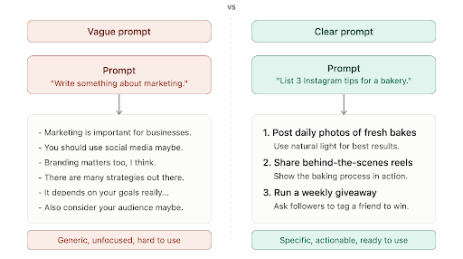
Think of it this way: if you give vague instructions to a human, you will get vague results. The same applies to AI. The clearer your instructions, the better the output.
What Is Prompt Engineering?
Prompt engineering refers to the construction of effective commands directed at AI users. Given the rapid evolution of this discipline, it should be no surprise that it is primarily focused on word selection. It provides practitioners with the opportunity to consider the context and sequencing of their requests. Enhanced prompt engineering produces superior AI outputs, thus minimising the anticipated variability typically associated with responses to requests.
How to write a good prompt
- Be Clear and Specific
Digital marketing can yield many results, so it is important to ask specific questions. Try asking questions such as “How can SEO help a local bakery get customers?” You’ll get a more useful answer if you tell AI what format you want, i.e., bullets, tables, or paragraphs.
- Give Some Background
The AI system needs more information about what you are looking for. Feed it information and tell it exactly what you need. For example: Assist me in developing a 30-day LinkedIn content calendar for a B2B software company to generate leads and improve brand awareness.
- Iterate and Refine
Your first prompt will rarely be perfect, and that’s okay. Treat prompting like a conversation: adjust wording, add detail, and change structure. Small tweaks often create big improvements.
Four Techniques You Should Know
Zero-shot prompting is the easiest. You just ask a question and provide no examples, and the AI uses what it knows. Use this technique for simple things and general information. It’s a safe first option.
Few-Shot Prompting is a technique where you provide a large language model (LLM) with a few high-quality examples (typically 2 to 5) before presenting the actual task. By showing rather than just telling, you teach the model the exact tone, format, or classification style you expect, resulting in highly accurate, structured outputs.
Chain-of-Thought (CoT) Prompting guides an AI to solve complex problems step-by-step before giving a final answer. This dramatically improves accuracy for logical, mathematical, or coding tasks by forcing the model to “show its work.”
Simply add a guiding phrase, such as “Let’s think step-by-step,” to your prompt.
Standard Prompt: “What is $5 \times 3 + 10$?” (Risk of a rushed, incorrect answer)
CoT Prompt: “What is $5 \times 3 + 10$? Let’s think step-by-step.”
By breaking the problem down, the model calculates intermediate steps (e.g., first solving $5 \times 3 = 15$, then adding $10$ to get $25$) instead of guessing the final number all at once.
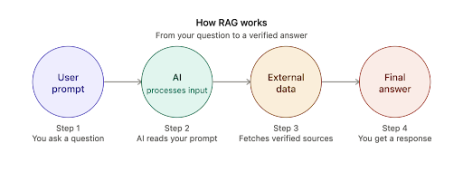
Retrieval-Augmented Generation (RAG) is a technique that connects an AI model to external, real-time data sources (like PDFs, databases, or websites) to answer questions.
Instead of relying solely on its static training memory, which can be outdated or incorrect, the AI pulls up-to-date, highly specific documents to draft its response. Think of it as giving the AI an “open-book exam.”
Common Problems When Writing Prompts and How to Fix Them
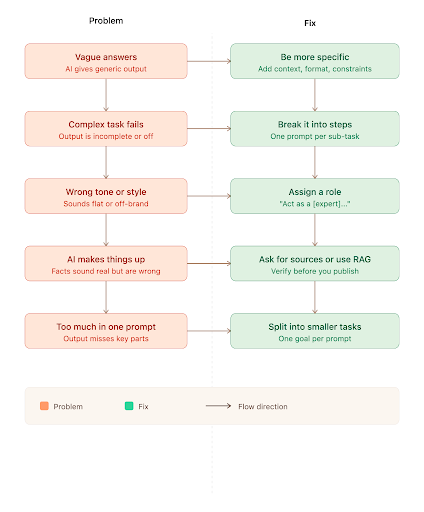
Most prompt-related failures follow a predictable pattern, and fixing them is straightforward once you know what to look for.
The output is too generic. This usually means the prompt was too vague. Fix it by adding specifics: who the audience is, what tone you want, and how long it should be.
The AI ignores part of your request. Long, multi-part prompts often get partially ignored. Break the task into clear, numbered steps rather than burying everything in a single paragraph.
The output looks right, but the facts are wrong. This is a classic case of the model filling gaps with convincing guesses. Give it the actual data or source material instead of relying on its memory.
The style or format keeps slipping. If you want a consistent tone or structure, show an example. Models follow patterns better than they follow descriptions of patterns.
A quick workflow for turning a vague idea into a prompt that actually works.
Define your goal. Before you type anything, get clear on what you actually want. A fuzzy goal produces a fuzzy result.
Choose a technique. Simple question? Zero-shot. Need a specific format? Few-shot. Logic problem? Chain-of-thought.
Write a clear prompt. Be specific about format, audience, length, and any constraints. Don’t assume AI will fill in the gaps the way you’re imagining.
Test it. Send the prompt and see what comes back. A prompt you thought was imperfect sometimes works brilliantly.
Evaluate the output. Is it relevant? Accurate? Complete? Is the tone right? This is where most beginners rush and where avoidable mistakes slip through.
Refine and repeat. Don’t start from scratch. Change one thing, test again. This loop is how good prompts get built.
 A Note on Ethics: The “Human in the Loop” Rule
AI is a powerful accelerator, but it is neither neutral nor infallible. Because it relies on historical patterns, it can easily replicate human bias or overlook critical context.
To see why blind trust in AI fails, consider these real-world pitfalls:
- Subtle Bias: An automated hiring email drafted without review that carries coded, exclusionary language toward older candidates.
- Context Blindness: A sprint summary that flawlessly captures routine updates but skips right over the one critical production outage leadership actually needs to know about.
- Flawed Inputs: A customer churn report built on skewed data that sends a retention team chasing the wrong fix for weeks.
Always treat AI output as a strong first draft, never the final word. When the stakes are high or the information is sensitive, a human must review, edit, and sign off.
Conclusion
The prompting problem is not going to resolve itself. As AI tools become more accessible and uniform, the gap between professionals who know how to direct them and those who don’t will become the defining productivity variable across every role, team, and industry.
Access to AI is no longer the differentiator. The thinking behind how you use it is.
The professionals who will get the most out of this shift are not the ones waiting for better tools. They are the ones building the habit of asking better questions, figuring out exactly what they need, clearly structuring their intent, and using AI to amplify their judgment rather than replace it. Prompt engineering is that habit made practical.
The good news is that the infrastructure to execute this properly now exists. Globant has been building precisely at this intersection, where technology meets human capability. Through the GUT Network, Globant brings together AI, digital marketing, content, Martech, and data analytics under one roof, purpose-built for teams that want to move beyond generic output. And with Globant FUSION, the first suite of AI agents designed for full-funnel execution, the focus remains on intelligent, scalable output that keeps human judgment at the center.
The techniques in this guide are ready to use today. The question, as always, is whether you are willing to do the harder work of giving those techniques something real to work with.