Unite Barcelona 2025: Interoperability, Speed, and the Future of Game Development
Unite Barcelona 2025 brought together developers, creators, and industry leaders from around the world to explore the latest innovations in modern interactive experiences. Organized by Unity Technologies, the event serves as a gathering point for insights into engine advancements and platform updates spanning games, simulations, XR, and beyond. Across keynotes, technical sessions, and hands-on labs, the community examined both the challenges and opportunities ahead as creators build for an increasingly diverse set of platforms and audiences.
Unity’s announcements throughout the event underscored a broader industry shift toward openness, speed, and collaboration, most clearly captured in the push for Interoperability and Ecosystem Unity. The technology landscape has evolved from isolated toolchains to interconnected workflows, shared standards, and cross-platform creation, opening new possibilities for teams of all sizes.
As a Unity Gold Partner, Globant was there to follow these developments closely, with Kevin Janzen, CEO of Gaming & EdTech AI Studio; Pablo Lecea, Technical Director of the Digital Twins Studio; and Nicolás Zapata, Delivery Director at Globant, engaging directly with the sessions, demos, and conversations shaping what comes next.
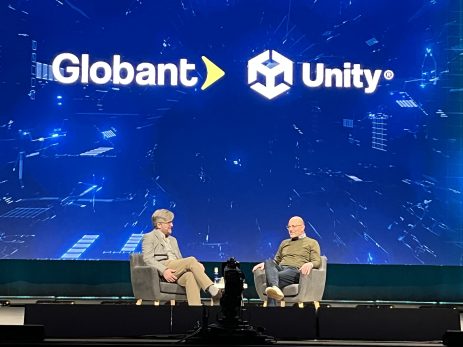
Kevin Janzen, CEO of Gaming & EdTech AI Studio, and Alex Blum, Chief Operating Officer at Unity.
The Industry Shocker: Unity & Epic Games Together
The biggest surprise of the event came when Tim Sweeney, CEO of Epic Games, joined Unity CEO Matt Bromberg on stage, a moment that signaled a real shift in how the industry thinks about collaboration. The long-standing “walled gardens” of game development are beginning to fall away. Together, they announced a partnership that will enable Unity-built games to publish directly into Fortnite, while Unreal Engine support will be integrated into Unity’s cross-platform commerce platform.
Sweeney compared this turning point to the early days of the web, noting that progress now depends on companies working together and respecting shared customer relationships. In line with this vision, Epic Games and Unity are jointly taking steps to foster greater interoperability and openness within the gaming ecosystem.
For creators, this opens the door to richer, more connected experiences, whether in next-gen entertainment or in industrial and enterprise-grade 3D workflows.
Development Speed & Production Verification
If interoperability stole the spotlight, Unity’s renewed focus on development speed came in a close second. With the Unity 6 series, the company is rethinking stability through a new concept: Production Verification. Instead of relying solely on internal testing, Unity is validating engine builds alongside real studios, such as its partnership with KONAMI on Survival Kids, to ensure tools are hardened in real production environments before reaching the wider community.
The announcement also highlighted PEAK, the breakout hit from Landfall Games, built in just 10 weeks. Zorro Svärdendahl described how the ability to assemble and iterate on environments without fighting rendering constraints freed the team to focus on defining the game’s identity rather than troubleshooting visual issues.
“Unity 6’s workflow improvements allow teams to prototype and validate ideas much earlier in the process. That acceleration is becoming essential for time-to-market, whether the goal is a new game mechanic or an industrial simulation. The ability to iterate faster ultimately raises quality and moves projects from concept to production far more efficiently.”
— Pablo Lecea, Tech Director, Digital Twins Studio.
Deploy Everywhere: Switch 2 & Android XR
Unite 2025 reinforced Unity’s position as a true multiplatform engine. The keynote highlighted launch-day support for Nintendo Switch 2™ and Android XR, underscoring Unity’s commitment to helping creators bring experiences to wherever players (and users) are.
The introduction of the Platform Toolkit also stood out, promising a far more streamlined way to integrate console and PC SDKs for achievements, saves, account management, and more. For teams used to juggling platform-specific requirements, this represents a meaningful reduction in overhead.
At Globant, these updates align closely with our ongoing work in Digital Twins and real-time 3D. Easier deployment across VR headsets and mobile devices, along with native Android XR support and the new Platform Toolkit, equips us to deliver complex, data-driven experiences without reworking core logic each time, thereby accelerating experimentation, scaling, and real-world adoption.
Commerce, Growth, and Smarter Operations
Unity also expanded its footprint beyond creation with updates focused on operating and scaling games. The new cross-platform commerce offering, which supports web shops, payments (via Stripe and Coda), and streamlined monetization, positions Unity as a more comprehensive ecosystem for post-launch growth. Alongside this, Unity Vector brings a data-driven approach to user acquisition, helping studios match the right players to the right experiences more intelligently.
These shifts reflect a broader industry movement: games are no longer defined solely by their development, but by their ongoing evolution over time. Studios are leaning into smarter operations, adaptive ecosystems, and player-centric design, patterns that align closely with trends highlighted in Globant’s latest Games report, particularly the rising importance of AI in development and live operations. For teams navigating this next era, understanding these forces is becoming just as essential as mastering the tools themselves.
An Industry Shaped by Openness and Acceleration
Unite 2025 was a clear presentation of how game development is shifting toward open ecosystems, faster iteration, and truly multi-platform creation. Unity’s leadership echoed this direction, reaffirming a commitment to giving creators greater control over how ideas move from prototype to playable reality.
What stood out most, however, was the broader sentiment that threaded the sessions and conversations: interoperability is becoming a foundation, not a feature, and the pace at which teams can experiment will increasingly shape what gets created and how quickly audiences experience it. As capabilities like the AI Gateway and Platform Toolkit continue to evolve, they signal a development landscape where possibility expands alongside efficiency.
For teams looking to navigate this next chapter, Globant’s Games AI Studio helps turn these emerging tools into production-ready solutions. Explore how our experts can support your next project and help bring new worlds to life.