




The conversation about artificial intelligence has grown up. Now, it’s less about what’s possible and more about making things happen. This shift marks a new phase in AI adoption in business and signals the need for a structured corporate AI strategy at scale.
Last week, Globant and Egg launched AI Talent Shift together. This new program aims to help organizations match their AI abilities with how well their people can adapt.
The event was led by Globant’s Education AI Studio, which supports organizations in rethinking learning for AI-native environments, turning AI adoption into a scalable capability. Through initiatives like AI Talent Shift, it drives collaborative upskilling with measurable impact in weeks, preparing teams for AI-powered ways of working. The initiative reflects Globant’s broader approach to AI business transformation and AI for digital transformation across industries.
Hosted as a Summit, the AI Talent Shift brought together leaders from academia, the public sector, the private sector, and media to move beyond theory and into real-world adoption.
Many AI initiatives focus on strategy and tools, but those alone aren’t enough. Scalable AI adoption requires a system that supports experimentation, fast feedback, and structured human oversight. AI Talent Shift addresses this need with a repeatable framework, built on Globant’s experience, that drives continuous, collaborative learning instead of one-off training.
From Theory to Reality
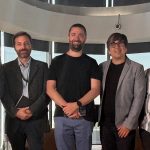
The morning opened with a keynote titled “From Theory to Reality: AI Adoption”, where Javier Scher , SVP of Technology & Head of Education AI Studio at Globant, and Nacho Gómez Portillo, Co-founder and CEO of Egg, explored how AI has already moved beyond experimentation. Organizations are now shifting from pilots to structured AI enterprise adoption, requiring intentional design rather than isolated initiatives.
The discussion brought together leading voices, including Alejandro Piscitelli (UBA / Nexus Labs), a systems thinker on complexity and future scenarios; Mayra Botta (Learning Manager, Globant), focused on culture and scalable AI transformation; Tomás Balmaceda, philosopher and technology journalist; and Rodolfo Barrere (OEI), expert in science and public policy.
Together, they underscored a critical shift: AI is no longer just assisting people; it is executing workflows and driving decisions with selective human oversight, fundamentally redefining the role of talent within organizations.
The focus, speakers emphasized, is no longer tool mastery. It is cognitive adaptability, the ability to operate alongside evolving systems that produce probabilistic, non-linear outcomes.
This perspective resonated strongly with the audience, especially when framed against projections from the World Economic Forum, which estimates that by 2030, 39% of today’s core skills will change. The implication is clear: traditional, static training models are no longer sufficient.
Three Perspectives, One Shared Challenge
The panel discussion, which included people from universities, government, and business, showed that even though organizations are at different stages with AI, everyone faces similar mindset challenges.
Several themes emerged consistently:
- AI adoption stalls without cultural alignment.
- Training that focuses only on tools delivers short-term gains.
- Psychological safety accelerates experimentation and value creation.
- Human oversight must be intentionally designed, not assumed.
- Adoption scales faster in collaborative learning environments.
Rather than presenting polished success stories, panelists shared practical challenges and lessons learned, grounding the conversation in operational realities.
Introducing AI Talent Shift
Against this backdrop, AI Talent Shift was presented as a structured framework designed specifically for AI-rich environments. Unlike conventional training initiatives, the framework was built to align human, technical, and cultural dimensions simultaneously. Its objective is not simply knowledge transfer, but measurable organizational adoption.
The initiative incorporates metrics that prioritize real impact:
- Applicability (ROL): Measuring how learning translates into execution.
- Relevance and Suitability (PA): Ensuring content remains practical and up to date.
- Completion (COM): Tracking engagement.
- Experience and Satisfaction (NPS): Gauging long-term adoption potential.
AI Talent Shift positions itself not just as training, but as an AI talent intelligence solution supporting sustainable AI adoption in organizations.
Cooperation as a Scaling Mechanism
Egg’s role in the project highlighted another important point: people adopt new things faster when they learn together as a community.
Egg’s Code Your Future program, developed for Globant, has already helped over 1,500 people train for tech careers, with 80% of them graduating. This shows that learning together in groups makes people more engaged and helps them apply what they learn.
This way of learning fits with a bigger idea from the event: changing with AI is just as much about culture and how people think as it is about technology.
What Comes Next
The event ended with everyone agreeing that AI transformation has entered a new stage. Having the technology isn’t what sets organizations apart anymore; being able to adapt is. Launching AI Talent Shift is a step toward making that adaptability something organizations can measure, repeat, and grow.
The future of work isn’t far off; it’s happening now. As AI adoption by industry accelerates, organizations must integrate evolving generative AI capabilities and emerging agentic AI capabilities into structured transformation roadmaps.
The discussions showed that organizations that see learning as ongoing and team-based will be best prepared to lead in workplaces shaped by AI, learn more about AI Talent Shift here.