AI’s transformative capabilities are being internalized to move beyond hype and toward delivering real value. For airlines, it has become one of the most powerful tools to realistically tackle the industry’s massive operational complexity. Nevertheless, success doesn’t come from AI in a vacuum, but from its combination with the right tools, data pipelines, classic algorithms, and machine learning models.
By automating processes, improving customer experience, and making core systems smarter, this synergy between the established and the novel is what delivers measurable ROI. In the airline industry, AI’s applicability across a wide range of operational and customer-facing areas is what enables meaningful transformation. Let’s take a closer look.
Automating the “Unseen” Backbone
AI automation delivers value not only in passenger-facing technology, but also in the complex, often invisible backbone of airline operations.
Take an interline cargo booking as an example. This is traditionally a slow, manual process that requires alignment between multiple carriers, spans time zones, and relies heavily on legacy systems. Today, AI agents are capable of interoperating with other airlines to automate cargo slot bookings. These agents can:
- Analyze cargo specifications
- Check complex agreements and routes in the Cargo Management System
- Communicate directly with other airlines’ AI agents using A2A protocols
- Book cargo slots autonomously, 24/7
Beyond dramatically accelerating the booking process, this approach prevents revenue leakage caused by delayed responses, reduces operational friction between partners, and unlocks opportunities that would otherwise be lost simply due to human or system latency.
From Rigid Systems to “Liquid” Solutions
For decades, the airline industry has been constrained by rigid development cycles. Launching a new service often takes months or even years. AI agents change this paradigm by allowing airlines to build by capability, not by channel.
Imagine a single AI agent designed to manage disruption. That same agent can be deployed simultaneously as:
- A voice interface in an interactive phone system
- A conversational chatbot
- The decision engine behind a dynamic web experience



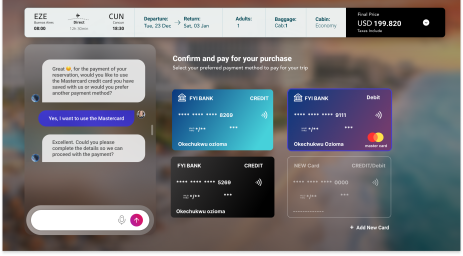
This composable approach enables faster experimentation and iteration. In some cases, the AI can even make decisions about the user interface itself, selecting components and shaping the user’s journey in real-time based on their context.
The result is the ability to introduce new products or channels on the fly, without rebuilding the entire experience, while consistently capturing the same operational and business benefits across touchpoints.
AI Doesn’t Just Optimize; It Makes Optimization Possible
Airlines already rely heavily on optimization algorithms, whether for fuel-efficient flight paths or the recovery of IROPs (Irregular Operations). But these algorithms are only as effective as the data they receive. This is where AI plays a critical enabling role.
Consider a typical IROPs scenario: a flight from São Paulo to Montreal is canceled. The reassignment algorithm must reroute hundreds of passengers. On paper, the most “optimal” route may involve a stopover in the United States, but the algorithm has no visibility into which passengers hold a valid U.S. visa or ESTA.
An AI agent can proactively contact affected passengers, request the necessary documentation, validate it through external services, and feed clean, verified data back into the optimization engine. With this enriched input, the IROPs algorithm can instantly eliminate infeasible options and make genuinely optimal decisions faster and with far fewer downstream failures. In this way, AI doesn’t replace optimization; it makes it operationally viable at scale.
Avoiding the Traps, Building the Advantage
I have identified three recurring mistakes that derail AI initiatives in airlines.
First, organizations chase the flash, a shiny generative AI chatbot, rather than the function, such as automating backend cargo booking. The fastest and most reliable ROI almost always comes from improving the “boring” but mission-critical processes.
Second, they treat generative AI as the entire solution. Significant investment goes into an impressive GenAI layer, but it remains disconnected from machine learning models, optimization algorithms, and core data systems. In isolation, GenAI is little more than a novelty.
Third, measurement is addressed as an afterthought. AI is deployed as a one-off project, rather than managed as a living product. Without clear quality metrics defined from day one, teams end up flying blind.
Real success means building a framework for fast iteration. This involves:
- Pre-production quality: Building golden datasets and defining quality metrics early to evaluate agent performance during development. This is the foundation for scalable, high-quality AI iteration.
- Production performance: Monitoring real-world behavior, such as accuracy, latency, and throughput.
- Business impact: Directly linking AI performance to core KPIs like cost reduction, incremental revenue, and customer satisfaction.
These examples are only the tip of the iceberg. The real, lasting opportunity lies in building capabilities for continuous, intelligent transformation. Airlines that master this, by connecting GenAI to algorithms, measuring relentlessly, and focusing on function over flash, will achieve sustainable success. The true competitive advantage isn’t a single tool or platform. It’s the ability to build a resilient, adaptive operation that turns every moment of customer interaction into a moment of trust. That’s not something you can buy. It’s something you have to build.
Globant’s Airlines AI Studio works alongside airlines to modernize their digital ecosystems, connecting AI, data, and core systems to turn complexity into a competitive advantage. From operational optimization to smarter customer experiences, we help airlines build the foundations for long-term efficiency, resilience, and growth.