


Agentic AI represents a paradigm shift in artificial intelligence, where systems not only process data but also autonomously plan, execute actions, and adapt to achieve specific goals. With 60 % of shoppers expecting to use AI agents in the next 12 months, the shift from generative to autonomous marketing technologies is essential. Yet despite the momentum, only about one-third of marketers say they’ve even tried agentic AI, meaning there’s a widening gap between those ready to scale and those still stuck in piloting mode.
Within the marketing landscape, professionals face escalating challenges: scaling operations amid vast data volumes, delivering hyper-personalized experiences to diverse audiences, maintaining speed in fast-paced markets, and navigating the complexity of multichannel data sources. These issues often lead to inefficiencies, missed opportunities, and suboptimal customer engagement. Forward-thinking creative partners like GUT Agency illustrate how modern marketing demands both bold ideas and smarter systems to keep pace with consumer expectations. Agentic AI seamlessly integrates into this transformation by automating decision-making processes, enabling real-time adaptations, and bridging gaps between data silos. By embedding AI into existing ecosystems, marketers can transcend traditional limitations, fostering agile and customer-centric strategies that drive sustainable growth.
The Shift from Reactive to Agentic AI
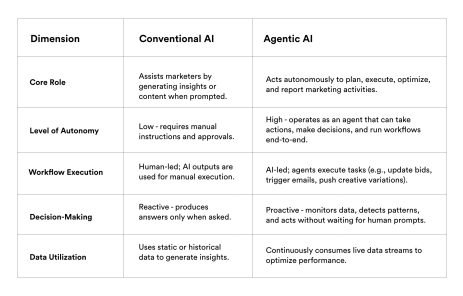
To grasp the potential of agentic AI, it’s essential to differentiate it from traditional AI. Conventional AI helps marketers by generating insights, predictions, or content, but only when humans request it and manually apply the output.
Agentic AI surpasses assistance by functioning as an autonomous system that can plan, execute, and optimize marketing tasks independently. This shift moves marketing from human-driven execution to AI-driven automation, where agents continuously monitor performance and take real-time actions. Let’s look at the image below to understand some key differences between them.
Conventional AI vs Agentic AI: A Clear Comparison Across Key Dimensions
Why Integrate Agentic AI into Marketing
Integrating agentic AI into marketing isn’t just a technological upgrade; it’s a strategic step required for staying competitive. The benefits are multifaceted. AI agents can personalize experiences at scale by processing vast amounts of customer data for tailored content in real-time, such as customizing product recommendations across millions of users. Real-time decisioning enables instantaneous adjustments, such as optimizing ad bids during peak traffic. Operational costs plummet as routine tasks are automated, freeing teams to focus on creative work. Faster campaign experimentation becomes feasible, as AI runs multiple variants simultaneously and scales the winners. Ultimately, this aligns with evolving customer expectations for seamless and intuitive interactions, leading to significant ROI improvements through higher conversions and increased loyalty.
Key Areas of Implementation in Marketing Ecosystem
Agentic AI reshapes marketing by acting like a tireless digital teammate that watches, decides, and acts across the customer journey. Instead of waiting for prompts, these agents constantly read the room, adjust tactics, and keep campaigns running at peak performance. This frees marketers to focus on strategy while the AI handles the shifting sands of data and execution.
- Campaign Management & Optimization: Agentic AI continually monitors campaign performance and makes real-time adjustments to budgets, bids, and targeting. It runs ongoing micro-optimizations that humans rarely have time to manage, driving higher efficiency with less manual effort.
- Content Creation: It generates tailored creative assets, from blog posts to social visuals, while preserving the brand voice. The agent adapts content to emerging trends and audience behavior, ensuring every asset feels timely and relevant.
- Customer Journey Orchestration: Agentic AI maps how users move across touchpoints and guides them through personalized pathways. It responds instantly to customer behavior, shaping journeys that feel intuitive rather than scripted.
- Conversational Agents: These agents provide natural, context-aware responses to customer queries across chat and messaging channels. They handle most interactions independently but know when to escalate complex cases to human teams for faster resolution.
- Predictive Analytics & Segmentation: Agentic systems forecast trends, shifting consumer interests, and purchase intent. They build dynamic audience segments that update in real time, empowering brands to run proactive campaigns instead of reactive ones.
How Leading Brands Are Winning with Agentic AI?
Several brands have successfully deployed agentic AI, yielding substantial impacts. L’Oréal is leveraging agentic AI to transform its creative, media, and retail operations with remarkable precision and efficiency. Through its Creaitech Lab initiative, the company integrates AI-driven creative development and media optimization to enable real-time content generation and automated budget allocation. By analyzing consumer data, these systems craft personalized, high-performing content for social and e-commerce channels, leading to a 22% increase in media efficiency and a 14% boost in campaign effectiveness following the 2023 rollout in the Nordics. Beyond marketing, L’Oréal’s agentic AI tools are reshaping digital retail management by automating product content updates, monitoring listing quality, and maintaining pricing consistency across global platforms. As CEO Nicolas Hieronimus highlighted during the company’s April 2025 earnings call, brands such as Redken and Kérastase are now officially listed on Amazon and Sephora.com, reflecting how AI is helping the company clean up unauthorized listings, standardize pricing, and drive visibility, compliance, and real-time operational control across L’Oréal’s expansive digital ecosystem.
Luxury lingerie brand Cosabella integrated the agentic AI platform Albert to overhaul its digital marketing strategy and regain growth momentum. Frustrated with agency-led results, the company adopted Albert to autonomously manage paid search and social campaigns. Unlike traditional AI tools that only deliver insights, Albert functions as a self-directed agent, analyzing user behavior, identifying emerging patterns, and autonomously executing campaign adjustments in real-time. It proactively optimized ad spend, scaled high-performing campaigns, and generated predictive insights to refine creative and messaging strategies. Within months, Cosabella achieved a 336% return on ad spend (ROAS) and a 155% increase in revenue, along with a 37% rise in website sessions and 20× growth in social purchases. By delegating decision-making and execution to an intelligent agent, Cosabella unlocked new levels of marketing agility and scalability. This example illustrates how agentic AI can transform marketing operations from manual oversight to autonomous performance acceleration, resulting in measurable business growth.
Steps to Implement Agentic AI in Your Marketing Ecosystem
Implementing Agentic AI isn’t about flipping a switch. It’s about preparing your data foundation, choosing meaningful starting points, and letting your teams and tools evolve together. A thoughtful rollout ensures that the AI becomes a reliable partner, rather than a complicated add-on. These steps help organizations introduce Agentic AI in a way that’s practical, controlled, and scalable.
- Assess Your Current Infrastructure: Begin by evaluating whether your data, tracking, and Martech stack are ready for AI-driven operations. This helps uncover gaps early, ensuring the foundation is solid enough to support automation and real-time decision-making.
- Define High-Impact Use Cases: Begin with focused, low-risk applications, such as chatbots or ad optimization. Early successes build confidence and momentum, laying the groundwork for expanding into broader, more complex Agentic AI initiatives.
- Choose the Right Platforms or Partners: Select platforms that strike a balance between reliability, compliance, security, and scalability. Weigh build-versus-buy decisions carefully so the solution grows with your business rather than limiting it.
- Integrate With Existing Workflows: Seamlessly integrate Agentic AI into your current processes, allowing teams to collaborate with it rather than being replaced by it. Human-in-the-loop oversight keeps execution safe, accountable, and aligned with brand goals.
- Measure, Learn, and Scale: Track performance using KPIs like engagement, conversions, cost efficiency, and ROI. As insights accumulate, iterate and expand Agentic AI across more functions to unlock greater operational scale.
Risks and Governance Considerations
While powerful, agentic AI introduces risks that demand careful governance. Data privacy and regulatory compliance are paramount, requiring adherence to standards such as the GDPR to protect user information. Avoiding “AI hallucinations” where systems generate inaccurate content is critical in customer-facing applications, mitigated through robust validation. Transparency and explainability foster trust, enabling stakeholders to understand AI decisions. Balancing automation with human oversight prevents over-reliance, ensuring ethical outcomes and accountability.
Conclusion
In summary, agentic AI provides a competitive edge in marketing through autonomous operations that tackle challenges and yield superior results. Brands like L’Oréal and Cosabella demonstrate their impact via enhanced personalization, efficiency, and ROI. In this landscape, Globant FUSION excels as a suite of specialized AI agents that transform full-funnel marketing, automate content generation, ad scaling, media creation, and landing page optimization for seamless integration and greater efficiency. Under human oversight, it drives smarter workflows, reduces costs, and scalable creativity. Start small, prioritize measurable ROI, and scale strategically for long-term success in an AI-driven world.