Keywords to Knowledge: Why Semantic Authority Defines the Future of SEO

July 7, 2026

How AI Search Agents Reward Depth, Context, and Brand Intelligence
3

The age of keyword-driven SEO is over. In the AI-first search era, brands win not by stuffing pages with phrases but by building Semantic Authority, a structured, verifiable knowledge ecosystem that AI systems cite as the definitive source of truth.

The Evolution Beyond the Keyword

For years, SEO was a numbers game: find the highest-search-volume keywords with the lowest keyword difficulty, and build content around them. Success simply meant matching user intent with relevant keywords.

The Shift that Transformed Search

The traditional search model shifted dramatically with the introduction of Google’s Search Generative Experience (SGE) in May 2023 and AI Overviews in May 2024. In this new landscape, AI-driven search platforms have moved past keyword density. Instead, algorithms prioritize information gain, heavily rewarding brands that deliver deep contextual value, distinct insights, and proven expertise.

What does it mean for SEO Professionals?

SEO Professionals are no longer writing for human searchers only; they must also build brand intelligence for AI assistants, agents, and LLMs. On the whole, the brands that teach AI models to cater to search intent will thrive, not those that chase rankings alone.

Breaking Down Misconceptions: What Semantic Authority Is NOT

  • Not Long-Tail Keyword Targeting: Writing encyclopedic articles stuffed with variations doesn’t equal authority. Volume does not mean the depth of a topic.  
  • Not Entity-Based SEO: Schema markup helps, but tagging alone doesn’t build trust. It helps machines recognize entities (people, places, products, organizations) in your content. Markups inform AI agents about the content, but they do not prove whether it is valuable or trustworthy. 
  • Not AI-Generated Content at Scale: The overproduction of AI-generated content creates an environment of digital dilution. It creates noise, not authority. The rise of AI should ideally elevate the value of human-driven thought leadership. 
  • Not Search Intent Optimization: Mapping content to buyer journeys is useful, but Semantic Authority is about educating AI, not just guiding humans.

Defining Semantic Authority: The Knowledge Era

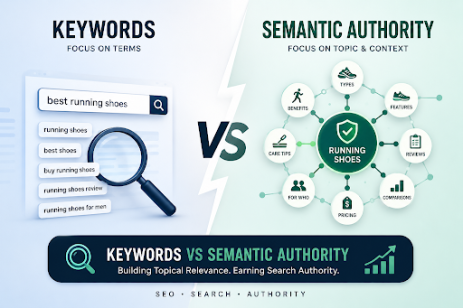
Semantic Authority is knowledge modeling. It’s about building dense relationships between entities in your brand ecosystem.

  • In the keyword era, the goal was to rank for queries.
  • In the AI era, the goal is to become an authoritative node, a trusted source of AI systems and agents. As an SEO professional, one must ensure that the content is fit for appearing in AI Overviews for nuanced answers.
  • Authority comes from context ownership: proprietary insights, structured relationships, helpful content, and unique data that fill gaps in training AI models.

Guidelines for Semantic Search Strategy  

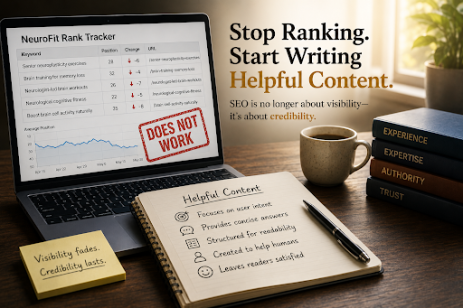
  • Start Writing Helpful Answers
    2

Visibility alone doesn’t win in the AI era, authority does. When your content provides unique insights and solves real problems, you stop competing for clicks and start becoming the source that powers the answers themselves.

  • Avoid the High-Volume Trap

Marketers often believe that targeting high‑volume keywords is the fastest way to capture market share. But in the AI‑driven search era, those broad, generic terms are treated as “commodity noise.” Because thousands of sites chase the same phrases, AI platforms view them as saturated and unreliable.

  • Salient Idea: Citation Is the New Ranking

Rankings can fluctuate constantly with algorithm updates, offering little stability. By contrast, when AI systems cite your brand, they validate your content as authoritative, trustworthy, and definitive on the subject. A single citation in an AI-generated answer carries far more weight than hundreds of backlinks because it embeds your brand directly into the synthesized knowledge users rely on. In this new paradigm, citations are the true measure of credibility.

Case 1 – The Running Shoe Example

Imagine you’re shopping for running shoes and you ask an AI platform or Modern-Day Search Engine: “What’s the safest, most durable shoe for flat feet?” Instead of showing you a bunch of keyword-stuffed online stores that only care about selling, the AI system looks for genuine expertise. It finds a small blog where a specialist explains how shoe design affects people with flat feet, using real biomechanical insights.


Case 2 – Mayo Clinic Example

When users ask AI assistants about medical conditions, generic health blogs rarely surface. Instead, Mayo Clinic is consistently cited because it has built a structured, entity-rich knowledge base. Its authority comes not from keyword targeting but from decades of proprietary medical expertise. In healthcare, it’s crucial to adhere to E-E-A-T guidelines, and Mayo Clinic has done so effectively. 

Practical Steps to Build Semantic Authority

  • Structured Content Architecture: Organize content around entities, not keywords.
  • Knowledge Graph Development: Map relationships between products, data, and expertise.
  • Proprietary Insights: Publish unique research, case studies, and datasets in list or tabular format that AI can’t find elsewhere.
  • Information Gain Focus: Ensure every piece of content adds some new value to the AI’s knowledge base.

Key Takeaways

The keyword era is over. In its place rises Semantic Authority, a model where brands succeed by teaching AI.
To thrive, marketers must:

  • Build structured, entity-rich content architectures.
  • Provide proprietary insights and unique data.
  • Think less about “ranking” and more about “being cited.”


Ultimately, modern content authority building is about becoming the intelligence behind the answers and helpful content.

At Globant, these advanced capabilities come to life through FUSION, the first suite of Enterprise AI Agents designed for full-funnel marketing. Running on Globant’s AI Pods subscription model, FUSION transforms traditional marketing workflows into intelligent, scalable systems that combine human creativity with AI-driven efficiency, providing the technological foundation brands need to compete in today’s fast-paced digital landscape.

Early clients have achieved impressive results: a 23% improvement in click-through rates, a 4x increase in asset creation, a 6x faster campaign adaptation, and a 3x reduction in production time. Dive deeper into what FUSION can do for you. 

The age of keyword-driven SEO is over. In the AI-first search era, brands win not by stuffing pages with phrases but by building Semantic Authority, a structured, verifiable knowledge ecosystem that AI systems cite as the definitive source of truth.

The Evolution Beyond the Keyword

For years, SEO was a numbers game: find the highest-search-volume keywords with the lowest keyword difficulty, and build content around them. Success simply meant matching user intent with relevant keywords.

The Shift that Transformed Search

The traditional search model shifted dramatically with the introduction of Google’s Search Generative Experience (SGE) in May 2023 and AI Overviews in May 2024. In this new landscape, AI-driven search platforms have moved past keyword density. Instead, algorithms prioritize information gain, heavily rewarding brands that deliver deep contextual value, distinct insights, and proven expertise.

What does it mean for SEO Professionals?

SEO Professionals are no longer writing for human searchers only; they must also build brand intelligence for AI assistants, agents, and LLMs. On the whole, the brands that teach AI models to cater to search intent will thrive, not those that chase rankings alone.

Breaking Down Misconceptions: What Semantic Authority Is NOT

  • Not Long-Tail Keyword Targeting: Writing encyclopedic articles stuffed with variations doesn’t equal authority. Volume does not mean the depth of a topic.  
  • Not Entity-Based SEO: Schema markup helps, but tagging alone doesn’t build trust. It helps machines recognize entities (people, places, products, organizations) in your content. Markups inform AI agents about the content, but they do not prove whether it is valuable or trustworthy. 
  • Not AI-Generated Content at Scale: The overproduction of AI-generated content creates an environment of digital dilution. It creates noise, not authority. The rise of AI should ideally elevate the value of human-driven thought leadership. 
  • Not Search Intent Optimization: Mapping content to buyer journeys is useful, but Semantic Authority is about educating AI, not just guiding humans.

Defining Semantic Authority: The Knowledge Era

Semantic Authority is knowledge modeling. It’s about building dense relationships between entities in your brand ecosystem.

  • In the keyword era, the goal was to rank for queries.
  • In the AI era, the goal is to become an authoritative node, a trusted source of AI systems and agents. As an SEO professional, one must ensure that the content is fit for appearing in AI Overviews for nuanced answers.
  • Authority comes from context ownership: proprietary insights, structured relationships, helpful content, and unique data that fill gaps in training AI models.

Guidelines for Semantic Search Strategy  

  • Start Writing Helpful Answers

Visibility alone doesn’t win in the AI era, authority does. When your content provides unique insights and solves real problems, you stop competing for clicks and start becoming the source that powers the answers themselves.

  • Avoid the High-Volume Trap

Marketers often believe that targeting high‑volume keywords is the fastest way to capture market share. But in the AI‑driven search era, those broad, generic terms are treated as “commodity noise.” Because thousands of sites chase the same phrases, AI platforms view them as saturated and unreliable.

  • Salient Idea: Citation Is the New Ranking

Rankings can fluctuate constantly with algorithm updates, offering little stability. By contrast, when AI systems cite your brand, they validate your content as authoritative, trustworthy, and definitive on the subject. A single citation in an AI-generated answer carries far more weight than hundreds of backlinks because it embeds your brand directly into the synthesized knowledge users rely on. In this new paradigm, citations are the true measure of credibility.

Case 1 – The Running Shoe Example

Imagine you’re shopping for running shoes and you ask an AI platform or Modern-Day Search Engine: “What’s the safest, most durable shoe for flat feet?” Instead of showing you a bunch of keyword-stuffed online stores that only care about selling, the AI system looks for genuine expertise. It finds a small blog where a specialist explains how shoe design affects people with flat feet, using real biomechanical insights.

Case 2 – Mayo Clinic Example

When users ask AI assistants about medical conditions, generic health blogs rarely surface. Instead, Mayo Clinic is consistently cited because it has built a structured, entity-rich knowledge base. Its authority comes not from keyword targeting but from decades of proprietary medical expertise. In healthcare, it’s crucial to adhere to E-E-A-T guidelines, and Mayo Clinic has done so effectively. 

Practical Steps to Build Semantic Authority

  • Structured Content Architecture: Organize content around entities, not keywords.
  • Knowledge Graph Development: Map relationships between products, data, and expertise.
  • Proprietary Insights: Publish unique research, case studies, and datasets in list or tabular format that AI can’t find elsewhere.
  • Information Gain Focus: Ensure every piece of content adds some new value to the AI’s knowledge base.

Key Takeaways

The keyword era is over. In its place rises Semantic Authority, a model where brands succeed by teaching AI.
To thrive, marketers must:

  • Build structured, entity-rich content architectures.
  • Provide proprietary insights and unique data.
  • Think less about “ranking” and more about “being cited.”


Ultimately, modern content authority building is about becoming the intelligence behind the answers and helpful content.

At Globant, these advanced capabilities come to life through FUSION, the first suite of Enterprise AI Agents designed for full-funnel marketing. Running on Globant’s AI Pods subscription model, FUSION transforms traditional marketing workflows into intelligent, scalable systems that combine human creativity with AI-driven efficiency, providing the technological foundation brands need to compete in today’s fast-paced digital landscape.

Early clients have achieved impressive results: a 23% improvement in click-through rates, a 4x increase in asset creation, a 6x faster campaign adaptation, and a 3x reduction in production time. Dive deeper into what FUSION can do for you. 

Share this post
Trending Topics
Data & AI
Financial Services
Globant Experience
Healthcare & Life Sciences
Media & Entertainment
Salesforce

Subscribe to our newsletter

Receive the latests news, curated posts and highlights from us. We’ll never spam, we promise.

More From

The Content & Social Studio connects brands with audiences through targeted content strategies. We leverage the power of AI to enhance community engagement and deeper customer relationships. Tailored social media and content strategies designed for each client.